How to Choose the Right Fryer Basket Size and Shape
The basket is the tool your line touches a thousand times a week. Pick the right one and service is smooth, oil stays clean and portions stay even. Pick wrong and you get snagged handles, uneven fries and oil that breaks down early. Here is how to match basket to fryer and menu without guessing.
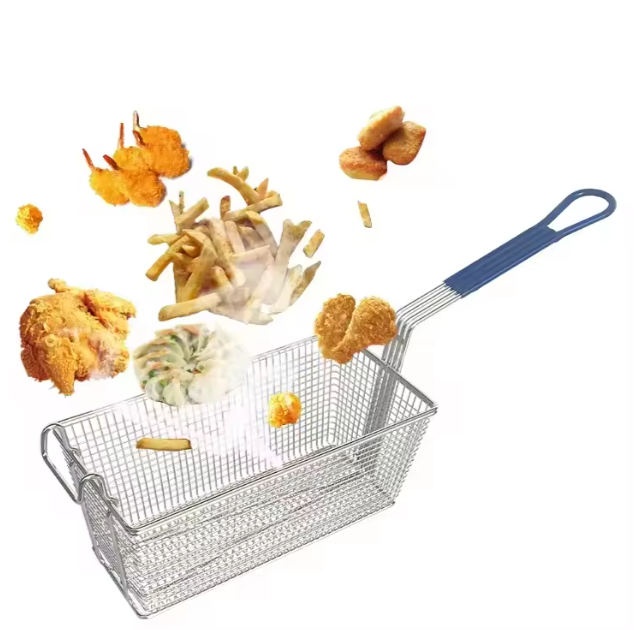
Start with the well, not the basket
Every sizing decision begins with the fryer, because the basket has to live inside it. Measure the inside of the oil well — width, length and depth — and write the numbers down before you look at any product page. A basket that is even slightly too wide will bind against the walls, scratch the fryer's finish and sit crooked, which shows up later as uneven browning on one side of every batch.
Depth matters as much as footprint. The basket should sit deep enough that food stays under the oil surface, with the handle resting comfortably on the fryer rim. If the basket rides too high, the top layer of fries cooks in steam and air instead of oil. If it sinks to touch the bottom, food rests on the sediment zone where the heat is harshest and the oil is dirtiest.
Leave breathing room. Oil needs to circulate around every piece of food, so the basket's outer dimensions should clear the well walls by a sensible margin on all sides. A basket that fills the well completely looks efficient and fries poorly — the oil in the middle of the batch cannot move, and the food near the walls overcooks while the center stalls.
Round or square: follow the fryer's geometry
The shape question answers itself for most kitchens. Round wells — the classic single-pot countertop fryers and many gas tube-fryer designs — take round baskets, which sweep the curved walls evenly. Square and rectangular wells, common in larger floor fryers and split-pot units, take square baskets for the same reason. The match keeps a uniform oil gap around the batch, and a uniform gap is what even frying is made of.
Where kitchens get creative is cooking style. Round baskets dominate where product is handled by the piece — onion rings, doughnuts, whole portions of fish — because the curved walls keep rounded items rolling gently rather than wedged in a corner. Square baskets dominate where food is portioned by volume: fries, nuggets, battered shrimp, anything scooped with a portion cup. The flat corners hold more product per shake and drain more predictably.
If your menu mixes both styles and your wells allow it, the honest answer is that most kitchens keep both shapes on the rack and assign them by product, not by philosophy. The mistake to avoid is forcing a square basket into a round well or the reverse — no amount of handle gymnastics fixes the dead zones that mismatch creates.
Mesh density: coarse, fine and pasta patterns
Mesh is the working surface, and its density should be chosen by what falls through. Coarse square mesh suits large, sturdy items — fries, chicken pieces, thick battered goods — because it drains fast, sheds crumb easily and survives a hard day without clogging. Fine mesh exists for small or light product: mini corn dogs, small shrimp, anything the coarse weave would let slip through or let float out during the shake.
Pasta and specialty patterns are their own category. Pasta baskets typically use a finer weave with lower walls, sized to lift a single portion cleanly out of boiling water. Multi-layer and shallower designs serve snack bars and smaller portions where a deep basket is clumsy. If your menu includes vegetables or delicate coated items, remember that a fine mesh also holds more oil on its surface after the shake — a small trade-off, but one that shows up in oil consumption over a month.
Wire diameter quietly separates professional baskets from consumer ones. Thicker wire resists the frame-bending that comes from routine knocking and stacking, and it holds welds longer at frying temperatures. When comparing quotes, ask for wire gauge and mesh opening, not just basket size — two baskets with identical footprints can be years apart in service life.
Capacity and portion planning
Size the basket to the batch, not the other way around. The rule that keeps oil stable and food crisp is the half rule: fill baskets no more than half full. Frozen fries especially — overloading drops the oil temperature sharply, and the product boils rather than fries, absorbing oil and turning limp. A kitchen that understands this often buys two medium baskets instead of one large one and runs them in sequence.
That is where twin and split-pot setups earn their keep. Two baskets in one fryer, or two baskets across a split well, let one line cook run two products at two paces — fries holding while fish crisps — without cross-flavoring or holding batches in the pass. Fast-food operations standardize this: one basket per product per station, matched to portion cups so every drop weighs the same.
A useful planning exercise: take your busiest menu item, note the portion size, and check that a half-full basket of that item still produces a serviceable batch per drop. If a half-filled large basket barely covers one order, the station will run behind at peak — you need either a bigger basket in a bigger well, or a second drop. If a half-filled small basket produces three orders, the basket is too small and the line will spend its day shaking and refilling.
Handles, hooks and the details you notice at hour six
The handle is where comfort and safety meet, and it is worth specifying deliberately. Crook handles that rest on the fryer rim keep the operator's hand away from the oil and let the basket drain hands-free on the hook — the standard pattern for high-volume lines. Longer handles keep hands further from heat in deep wells. Insulated or silicone-grip covers help where staff handle baskets continuously through a shift, and they earn their premium in busy kitchens.
Check the hook geometry against your fryer rim. A basket that cannot hang securely on the rim's edge turns every drain cycle into a two-handed juggling act over open oil. Most commercial rims accept the standard hook profile, but older or specialty fryers vary, and a photo of your rim sent to any manufacturer is cheaper than a wrong batch.
One more detail: handle height above the oil surface. After a drop, steam and spatter rise around the handle root. Handles set too low collect baked oil at the junction where handle meets frame — the first place we see corrosion failures on returned samples. A well-designed basket keeps that junction above the splash zone and makes cleaning it easy.
Material and build: what the basket is made of
Stainless steel is the default for commercial service, and the grade matters. 304 stainless handles the salt, the moisture and the wash chemicals of a busy kitchen with minimal corrosion; 201 stainless keeps cost down and works acceptably where baskets are well maintained and replaced on schedule. We break down that trade-off in depth in our 201 vs 304 comparison — the short version is that high-volume sites almost always end up preferring 304.
Look past the material to the joints. Welded construction holds up through thermal cycling far better than spot soldering, and the frame should be one continuous welded loop rather than wire joined at corners. Run a thumbnail around the frame of any sample: if you feel a step or a sharp point at a joint, that is where the basket will fail first.
Finally, match the build to your washing reality. Baskets that go through a dish machine need welded frames and no coatings; plated baskets of any kind should stay out of the dish machine, because the wash strips the plating and starts rust within weeks. If your dish pit is the default home for every tool in the kitchen, buy for the dishwasher, not for the brochure.
A five-step sizing checklist
Measure the well: inside width, length and depth at three points, and note any sensor probes or baffles that intrude into the space. Choose the shape: round for round wells and piece-handled product, square for rectangular wells and volume portioning. Pick the mesh: coarse for sturdy large items, fine for small product, pasta patterns for boiling work.
Check capacity against the half rule and your busiest portion — two baskets per station often beats one large one. Then settle the handle: crook type matched to your rim hook, length matched to well depth, grip matched to your staff's shift reality.
If any measurement is uncertain, send us the fryer brand, model and the numbers you have. We manufacture to OEM sizes for mainstream fryers and cut custom baskets to drawing, and a two-line email with your well dimensions usually settles the question inside a day.
Further reading
LOHP — Preventing Burns from Hot Stuff: deep fryer filling and handling practices (Berkeley Labor Occupational Health Program)
NFPA 96 — why hood and exhaust design shapes the equipment that goes into it (nfpa.org)
Quick answers
Should I use a round or square fryer basket?
Follow the well. Round wells take round baskets, square or rectangular split-pot fryers take square baskets. The shape that matches your well clears the walls evenly and fries uniformly.
How full should a fryer basket be?
Fill baskets no more than half full. Overloading drops the oil temperature, makes food absorb more grease and sends bubbles over the rim.
What size basket do I need for my fryer?
Measure the well's inside width, length and depth, then leave clearance on every side so oil can circulate. Send us the measurements or the fryer model and we will match a basket that fits.
Not sure which basket fits your fryer?
Send your fryer model or well measurements — we will match a basket from our range or quote a custom size within 24 hours.