Commercial Fryer Basket Sizes: Full, Half and Split-Pot Fit
Basket sizing vocabulary gets used loosely in catalogs and kitchens alike. Full, half, twin, split-pot — the words describe workflows more than dimensions, and two suppliers rarely mean exactly the same thing by them. Here is what each size class actually is, which fryer it belongs to, and how to verify a replacement before you pay for it.
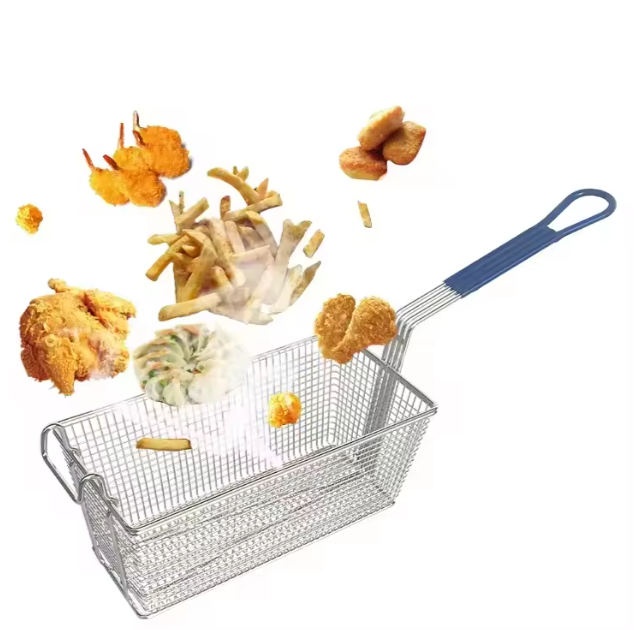
The size classes and their real dimensions
Commercial basket sizing clusters around a few practical classes. The numbers below are the working dimensions most manufacturers build to — treat them as the map, then verify against your own vat before ordering.
Full-size basket. Roughly 13 by 13 inches and larger, with 6-inch walls as the common depth. One full basket fills a single-pot floor fryer and matches it batch for batch. This is the standard tool for fries-forward menus where one product dominates the station and volume is the point.
Half-size basket. About 13 by 6 inches — same length as a full, half the width — so two sit side by side in one well, or one occupies a split pot. Half sizes are the flexibility tools: two products fried at two paces, smaller drops that recover oil temperature faster, and portion control that survives staff turnover.
Split-pot baskets. A split-pot fryer divides one vat into two independently controlled halves, and its baskets are half-size by definition. The match matters: a basket made for a full pot will not seat correctly in a split well, and forcing one blocks the divider's seal.
Countertop and round-well baskets. Compact countertop fryers and classic round-well designs take proportionally smaller or round baskets. The logic is the same as any other class — match the well's geometry — only the numbers are smaller, typically 8 to 10 inches across.
Pasta and specialty formats. Round pasta inserts in the 5 to 6.5 inch range serve boiling stations rather than fryers. Taco-shell and tostada baskets are shaped tools, bought for the menu item rather than the vat. Both deserve their own buying decision, separate from the fry-line set.
Full pot, split pot or twin baskets: the workflow math
The right class is a workflow decision before it is a dimensional one. A full-pot setup with a single large basket is at its best when one product runs in volume: big batches, few drops, simple training. The trade-off is rigidity — fries and fish in the same basket means one waits while the other finishes, and flavors travel.
Twin half-size baskets in one well change the pace. Two products can drop, shake and leave independently; small batches recover oil temperature faster, which keeps crispness consistent through a rush. Fast-food kitchens standardized this pattern for a reason, and any menu with three or more fried items benefits from it.
Split-pot wells add temperature control to the same geometry. One half runs fish at a lower set point while the other runs fries hot — no cross-flavor, no compromise set point. The cost is capacity per drop, since each half holds half the oil volume and cools faster under load. High-volume chicken operations, which need deep batches and stable temperature, usually stay full-pot; mixed menus lean split or twin.
One caution applies to every layout: basket count does not multiply capacity. The vat's recovery rate is the ceiling. More baskets on one well simply divide that ceiling into smaller, faster portions — which is often exactly what service wants, but it is not more oil capacity.
Checking a replacement against your fryer
Replacement baskets are ordered wrong more often than any other smallware, usually by buyers who matched a photo instead of a vat. The five-minute check prevents most of it:
1. Measure the well inside. Inside length, inside width, and depth from the oil line to the floor of the vat. Write the numbers down; memory rounds generously.
2. Compare outer dimensions. The basket should clear the walls on all sides by a sensible margin — enough for oil to circulate around every piece, not so much that the batch hugs one wall.
3. Check depth against the rim. With the handle resting on the fryer rim, the basket floor should sit above the sediment zone and the food should sit below the oil surface. Too shallow, and product rides in steam; too deep, and it rests where the elements burn crumbs onto it.
4. Look at hanging hardware. Front hooks, rim rest, or support tabs — the basket must hang level on your fryer's hardware, and hanger styles vary between manufacturers. If you use basket hangers as a staging rack, confirm the hook spacing matches.
5. Confirm the handle. Length, angle and coating. A handle that clears the backsplash on one fryer may swing into a wall on another, and plastic coatings age differently than double-dipped ones in continuous service.
When standard sizes do not fit: OEM sizing
Non-standard wells are common enough that custom basket sizing is an ordinary order rather than a curiosity. Older floor fryers, imported countertop units, split-pot dimensions that drifted between brands, and specialty products that need their own footprint all end up in the OEM lane. A manufacturer who builds baskets from wire needs the same inputs you would give for any fabrication: outer dimensions, depth, mesh opening, wire gauge, handle type and hanging hardware.
The economics usually favor custom when a kitchen is committed to its fryer. A near-miss standard basket costs less up front and more every shift it is used — in shake time, in uneven batches, in the workarounds staff invent to keep food from snagging on a frame that does not quite fit. Send the vat's measurements rather than the old basket's, because the old basket may be the reason the station has been slow for years.
Wire gauge and weld quality deserve the same attention as footprint. Thicker wire holds its shape through years of thermal cycling and knocks; finer mesh suits breaded and small products at the cost of slightly slower draining. A quote that specifies only length, width and depth is incomplete — ask what the basket is made of, and how, before comparing prices.
A practical size chart for the most common setups
For quick reference, the pairings that cover most commercial kitchens: a single-pot 40 to 50 lb floor fryer takes one full-size basket, or two half-size twins. A split-pot 30 to 40 lb unit takes one half-size basket per half. Countertop 10 to 15 lb units take compact baskets of 8 to 10 inches. Round-well fryers take round baskets matched to the well diameter. Pasta stations take round fine-mesh inserts of 5 to 6.5 inches, one per portion being boiled.
Treat every pairing as a starting hypothesis, not an order form. The five-minute vat check from the previous section is the difference between a basket that drops into service and one that becomes a shelf ornament. And when the well is genuinely odd, send the measurements — a factory that meshes its own wire can hold a custom footprint as easily as a standard one.
Quick answers
What is the difference between a full-size and half-size fryer basket?
A full-size basket is roughly 13 by 13 inches or larger and fills a single-pot vat; a half-size basket is about 13 by 6 inches, so two fit side by side in the same well or one half of a split pot.
Will one basket size fit every fryer?
No. Full and half are workflow conventions, not universal dimensions, and manufacturers vary. Measure the well's inside length, width and depth, then check the basket's outer dimensions and hanging clearance against those numbers.
When is a split-pot twin basket setup the better choice?
When the menu separates products — fries in one half, coated items in the other — or when batches are small but frequent. Twin baskets prevent flavor transfer, pace two products independently, and keep every drop small enough to recover oil temperature quickly.
Further reading
→ Fryer accessories buyer's guide: full-size and half-size basket dimensions (katom.com)
→ Choosing the right commercial fryer basket: types and twin setups (chefstop.ca)
Related guides
→ How to choose the right fryer basket size and shape
Non-standard vat? We build to it.
Send your fryer's inside dimensions and hanging hardware type — we mesh, weld and size baskets to your wells, from full-pot workhorses to split-pot twins.