Pasta Baskets in a Commercial Kitchen: Uses Beyond Pasta
Every pasta station knows the round mesh insert on a long handle. What surprises newer kitchens is how much else that simple tool does — blanching, reheating, straining, portion control — and how much calmer a boiling station runs when one basket serves one order, start to finish.
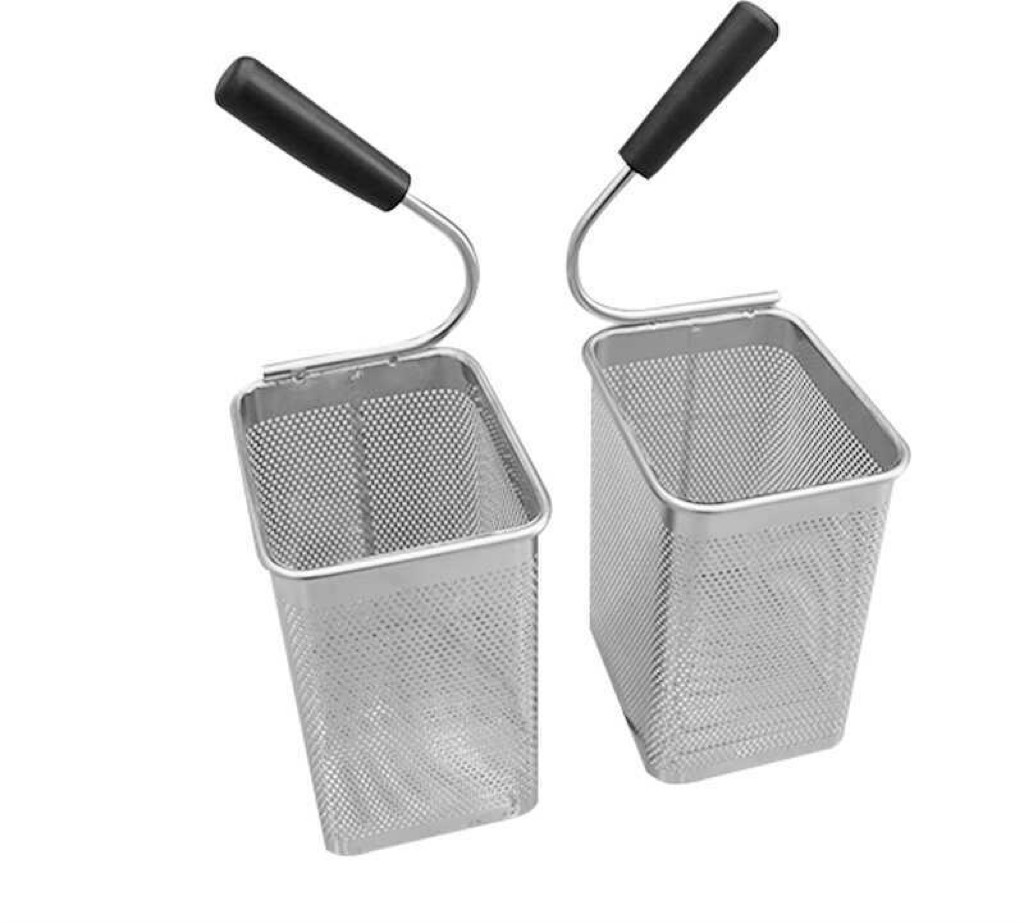
What a pasta basket actually is
The format is deliberately plain: a round or slightly tapered mesh body, typically 5 to 6.5 inches across with 5 to 8 inch walls, in fine stainless wire, on a handle long enough to reach the bottom of a stockpot without the cook's hand crossing the steam. Most commercial inserts use 18/8 stainless for mesh and frame, with a coated handle for grip. The mesh is finer than a fryer basket's — fine enough to hold orzo, small vegetables and noodles that would slip through a coarse fry weave — while still draining a full portion in seconds.
The round shape is not decoration. It matches the round walls of stockpots and pasta cookers, keeps long strands curling naturally instead of wedging in a corner, and lets the cook swirl the basket through the water with a wrist motion rather than lifting and stirring. A hand-welded frame resists the warping that pressed frames develop after a few hundred boiling cycles.
One tool, one order, one lift: that is the design brief. Everything a pasta basket does well follows from it.
The five jobs it does every service
Portion boiling. The core job. Dried pasta portions live in containers beside the pot; at the order, a portion drops into a basket, the basket drops into rolling water, and the cook agitates with a swirl. At service, one lift drains the whole portion in the basket — no colander crossing, no lost seconds, no stray strands down the drain. Kitchens running several pasta dishes at once keep four or six baskets in rotation against one big pot, each basket mid-cook at its own moment.
Blanching vegetables. Broccoli, green beans, asparagus and carrots go into the basket, into the water for their minute, then straight into an ice bath or the sauté pan. The basket carries the portion the whole way, and fine mesh holds the small cut pieces a colander would shed.
Reheating. Cooked dumplings, stuffed pastas, udon and leftover rice portions reheat in sixty to ninety seconds in a basket. The mesh lets water reach every surface, and the lift-out means the item never sits in water a second longer than it needs to — the difference between revived and waterlogged.
Straining stocks and sauces. In a pinch, the fine mesh takes a second job straining a small batch of stock, blanching tomatoes for peel-and-seed work, or lifting aromatics from a pot. It is not a chinois and will not replace one at volume, but for a quart-scale task it saves washing a dedicated strainer.
Order tickets you can see. A less obvious use: stations that cook to order assign one basket per open ticket, lined up on the pot's edge. The row of baskets is the station's queue, visible at a glance, and nothing waits in a pile.
Choosing a basket that survives the station
Three checks separate inserts that last a season from ones that last years. First, fit: measure the pot's inside diameter and confirm the basket clears the walls by a margin that lets water circulate — a basket wedged tight against the pot walls boils unevenly and scratches both surfaces. Check the reach, too: with the handle hooked on the rim, the basket body should sit fully below the water line with room above for a rolling boil not to spit over.
Second, mesh and frame construction. Look for welded joins between mesh and frame rather than crimped ones, and wire thick enough to resist the denting that comes from daily knocks against pot rims. Fine mesh that has already started separating from its frame at the factory will finish separating in your pot, and loose wire ends in food are a health inspection finding waiting to happen.
Third, the handle. Coated handles protect hands through a long shift; check that the coating covers the grip fully and that the handle-to-frame weld is the strongest joint on the tool, because it carries the full weight of a wet portion at arm's length, dozens of times an hour. A wobble in a new basket is a break in a used one — send it back before it enters service.
Care, cleaning and the starch problem
Pasta baskets die of starch, not of work. Boiled starch builds up in the mesh weave service by service, narrowing openings and slowing drainage until the basket holds water instead of shedding it. The fix is routine: at the end of each day, soak the baskets in hot water with a mild degreaser or a vinegar solution to dissolve the film, brush gently with a soft brush along the weave, rinse and hang to air-dry. Hanging by the handle matters — baskets stacked wet trap moisture against the mesh and stain.
Never scrape the mesh with steel wool or a metal spatula. Stainless survives a dishwasher cycle without complaint, but an abraded weave holds starch permanently after the first aggressive scrubbing, and the coating on handles peels under the same treatment.
Inspect the handle weld monthly as part of the station's closing routine, the same window you would check tongs and fryer baskets. A basket is a low-cost tool, which is exactly why kitchens keep using the failing one — but a dropped basket of boiling water at arm's length is not a low-cost event. Retire inserts at the first sign of frame distortion or handle movement; the replacement price is trivial next to a burn claim.
Pasta basket, colander or fryer basket: picking the right mesh tool
The three overlap enough to confuse a buying list, so the honest comparison helps. A colander drains but cannot cook — every portion crosses two tools and loses heat between them, and small items escape. A fryer basket cooks and drains in one tool but its coarse weave sheds small product and it is shaped for oil, not a rolling boil. A pasta basket is the purpose-built middle: fine mesh for small product, round profile for the pot, handle reach for safety, and durability sized for boiling rather than frying.
The line blurs occasionally in practice — kitchens do blanch fries in pasta baskets, and some do fry small delicate batches in fine-mesh inserts — and a well-built insert survives the borrowed duty. But tools that live borrowed duties wear borrowed lives: a pasta basket pressed into daily fry service ages its coating and mesh far faster than its design intends. Buy the format for the station, and let each tool do its own job most days.
For kitchens setting up a boiling station from scratch, the working set is simple: one large stockpot or pasta cooker, four to six inserts in the portion size your menu actually sells, a landing rack beside the pot for draining, and a soak tub for the overnight starch wash. That arrangement serves hundreds of covers a night with nothing else added.
Quick answers
What size pasta basket fits a standard stockpot?
Common inserts run 5 to 6.5 inches in diameter with fine mesh walls, sized to sit inside a standard stockpot or pasta cooker with clearance for water to circulate around the mesh. Measure the pot's inside diameter and check that the insert clears the walls and reaches below the water line.
Can a pasta basket go in a deep fryer?
Occasionally, for delicate or small items in boiling-adjacent tasks like blanching fries — some kitchens use them that way. But pasta baskets are built for boiling water, not sustained frying heat and batter load, so a dedicated fryer basket remains the right tool for the fry line.
Why use a pasta basket instead of a colander?
A basket cooks, portions and drains in the same tool — the pasta never leaves the boiling water until the moment of service. A colander only drains, so portions lose heat and time crossing between pot and sink, and small items escape over the rim.
Further reading
→ Commercial pasta/blanching basket example: 6.5-inch fine mesh, 18/8 stainless (katom.com)
→ Basket type guide: where pasta baskets sit among fryer basket formats (chefstop.ca)
Related guides
→ How to choose the right fryer basket size and shape
Equipping a boiling station?
Send your pot sizes and portion volumes — we build fine-mesh pasta baskets to your dimensions, with welded frames and handles that survive the shift.